
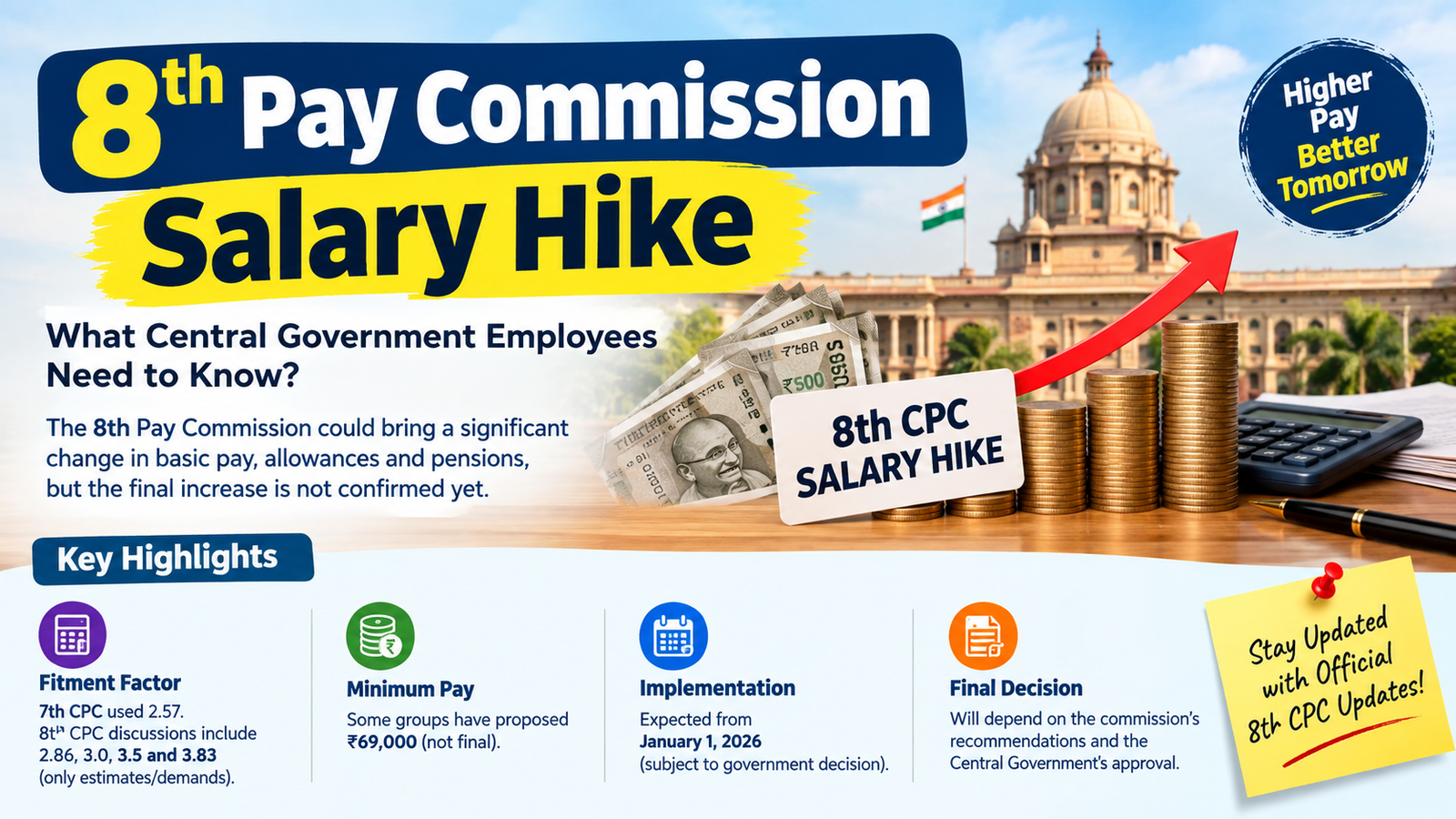
Central Government Employees and Pensioners are discussing significant topics in 2026 such as the salary hike under the 8th Pay Commission. The pay, allowances, pensions and service matters have been reviewed by the commission but salary hike final announcement is awaited.
At this source, 8th Central Pay Commission (8th CPC) was officially constituted by the Government of India on November 3rd, 2025. It has been tasked with producing its recommendations within 18 months. Stakeholder consultations and state visits are still ongoing, as reflected by the official commission website.
So, any 2.57, 2.86, 3.0, 3.5 or a 3.83 fitment factor must not be considered as the last word for the raise in salary under the 8th Pay Commission. Some of these numbers are calculation scenarios or demands by workers’ organisations, rather than government-approved figures.
What Is the 8th Pay Commission Salary Hike?

The Central Government sets up a Pay Commission to scrutinise all aspects of the salary structure, allowances, retirement benefits and other service conditions of Central Government employees/pensioners.
The 7th Pay Commission recommendations were implemented in 2016. According to the Union Government, Pay Commissions are typically formed at intervals of around 10 years and thus, employees are paying much attention to the 8th CPC.
Justice Ranjana Prakash Desai is the chair of 8th CPC while prof Pulak Ghosh and Pankaj Jain are part time member and member-secretary respectively.
The commission is likely to look into various aspects of compensation including pay structure and pension issues. The Central Government would then have to deliberate on and approve its recommendations.
8th Pay Commission Salary Hike: What Is Confirmed?
So far, no official percentage hike in salary has been announced under the 8th Pay Commission.
The government hasn’t also revealed a final fitment factor. The commission continues with ongoing consultations with workers, pensioners and other stakeholders. According to the official 8th CPC website, the Commission sought memoranda and suggestions from Central Government employees, Defence Forces personnel, pensioners, unions and other entitled groups from March 5 to June 15, 2026.
Therefore salary calculators available online that show a specific reformed salary should be read as demonstration calculations.
The last raised will depend on the suggestions of the commission and on how the government chooses to act.
What Is the Fitment Factor?
Fitment factor is a multiplier that will apply for calculating new basic pay under a different Pay Commission.
A simplified calculation is:
Where Revised Basic Pay = > Present Basic Pay X fitment factors
Say till now an employee whose basic pay is ₹18,000.
Using some imaginary fitment factor of 2.57:
₹18,000 × 2.57 = ₹46,260
Assuming a fictitious fitment factor of 2.86 would mean:
₹18,000 × 2.86 = ₹51,480
Note that none of this means either 2.57 or 2.86 will hold as the ultimate 8th CPC factor. They merely show the impact of how the multiplier is operating on basic pay.
7th Pay Commission vs 8th Pay Commission
The 7th Pay Commission had an element of the fitment factor at the rate of 2.57. Discussions on the 8th CPC are in place, but there are different views as to what is going to be the number; however no approval has been made yet.
The most recent calculations include scenarios such as 2.75 and 3.5 published in September of this year, while employee groups have made requests for much more extravagant numbers, such as a fitment factor of 3.83 These are scenarios and proposals, but not the final decision of the government.
This is why any proposed fitment factor should not be seen by employees as an officially announced salary hike.
8th Pay Commission Salary Calculation at Different Fitment Factors
The table below reflects how basic pay could be mathematically altered across hypothetical fitment factors.
| Current Basic Pay | 2.57 Factor | 2.86 Factor | 3.00 Factor | 3.50 Factor | 3.83 Factor |
| ₹18,000 | ₹46,260 | ₹51,480 | ₹54,000 | ₹63,000 | ₹68,940 |
| ₹19,900 | ₹51,143 | ₹56,914 | ₹59,700 | ₹69,650 | ₹76,217 |
| ₹21,700 | ₹55,769 | ₹62,062 | ₹65,100 | ₹75,950 | ₹83,111 |
| ₹25,500 | ₹65,535 | ₹72,930 | ₹76,500 | ₹89,250 | ₹97,665 |
| ₹29,200 | ₹75,044 | ₹83,512 | ₹87,600 | ₹1,02,200 | ₹1,11,836 |
| ₹35,400 | ₹90,978 | ₹1,01,244 | ₹1,06,200 | ₹1,23,900 | ₹1,35,582 |
| ₹44,900 | ₹1,15,393 | ₹1,28,414 | ₹1,34,700 | ₹1,57,150 | ₹1,71,967 |
| ₹56,100 | ₹1,44,177 | ₹1,60,446 | ₹1,68,300 | ₹1,96,350 | ₹2,14,863 |
Note: for illustration purposes only using some dummy numbers They in no way reflect the final 8th Pay Commission salary matrix.
In a recent exercise by the media, this mathematical calculation of a ₹35,400 Level 6 basic salary would `magically’ rise to ₹97,350 at 2.75 as well as to ₹1,23,900 at 3.50. That would translate into a basic pay of ₹1,54,275 and ₹1,96,350 in the case of those on a ₹56,100 Level 10 basic as per those scenarios.
Will the 8th Pay Commission Double Salary?
The basic pay can get a very large magnitude increase with a high fitment factor, but that does not mean the total monthly salary of an employee will get multiplied by two in all cases.
CTC also may include various components that make a part of actual take home salary.
- Basic pay
- Dearness Allowance (DA)
- House Rent Allowance (HRA)
- Transport Allowance
- Other applicable allowances
- Deductions and contributions
Hence, basic pay multiplied by a fitment factor is in no way equivalent to your actual final take home salary.
For instance, if the CTC works out to ₹35,400 per month for an employee then using a hypothetical factor of 3.5 gives ₹1,23,900. But the monthly salary after the 8th CPC will be decided by a new pay matrix and treatment allowed.
What Is the ₹69,000 Minimum Salary Demand?
A recent development in the discussion of creation of 8th Pay Commission is demand from employee and pensioner organisations seeking ₹69,000 minimum basic pay.
A few employee bodies are also demanding a fitment factor of 3.83. The computation has direct relations with the current minimum basic pay of ₹18,000
₹18,000 × 3.83 = ₹68,940
This is approximately ₹69,000.
This demand is something submitted by the employee organisations and not provided or sanctioned by the Government of India or acknowledged as finalised figures before the 8th Pay Commission Recommendations.
This distinction matters when discussing the proposed 8th Pay Commission salary hike.
How Much Salary Hike Can Employees Expect?
One only counts for so many percentages; it is too early to have one firm figure.
As an example, consider the difference in the basic pay if it is changed from ₹ 18,000 to ₹ 51,480 under a hypothetical multiplier of 2.86 the maths shows:
₹51,480 − ₹18,000 = ₹33,480
That simple multiplication corresponds to a basic-pay number 186% higher than that original figure.
Nevertheless, this should not be characterized as a guaranteed 186% pay rise. Because the 7th Pay Commission calculations are purely based on modifications in existing pay, allowances and any other piece. Your ultimate system might not be as simple as multiplying each employee’s current pay by a single number.
What will be the final pay hike, therefore, will only become clear once the commission recommends a new structure and the government decides.
Impact of Dearness Allowance on the Salary Revision
One more important point in terms of analysts talking about the 8th Pay Commission is Dearness Allowance.
DA: Dearness allowance; a cost of living adjustment paid by the Government of India to Central Government Employees and pensioners, periodically revised. During the 8th CPC discussions, employee and pensioner organisations have also raised the demand to merge at least some part of DA with basic pay.
That said, there is a confirmed salary structure to address but then all assumptions along the lines of a future DA merger should be considered independent.
The near actual monthly salary after implementation can seriously be altered in future due to ultimate treatment of DA, HRA and other allowances.
When Will the 8th Pay Commission Report Come?
The Constitution of the 8th Central Pay Commission has been offered on the grounds that assigning its recommendations will require around eighteen months. The commission will be formed on November 3, 2025, so the general time frame of 18 months puts us in May 2027.
The commission is still in the process of consultations and visits. Upcoming activities have been listed up to its official website, including an October 7–8, 2026 Bengaluru visit and an October 22–23, 2026 Mumbai visit.
Submission of the report will not ensure that revised salaries are disbursed right away. Implementation details will be finalized once the government studies and accepts the recommendations.
Will Employees Get 8th Pay Commission Arrears?
The matter of arrears is also tied to the effective date.
The impact of the 8th CPC is the time expected around January 1, 2026 as per normal schedule of occurrence every ten years, according to government signals. The actual dates of payments and how the notional benefits will be dealt as arrears is going to depend on the final decision by the government post recommendations of committee submission.
As a result, it is too early to propose any one amount for arrears.
If complying is postponed beyond the effective date, the sum due on account of any such revisions may be decided in terms of the recognised revised pay, allowances and months covered.
8th Pay Commission Salary Hike: Key Numbers at a Glance
| Item | Current Information |
| Previous Pay Commission | 7th CPC |
| 7th CPC Fitment Factor | 2.57 |
| Existing minimum basic pay | ₹18,000 |
| 8th CPC Constitution Date | November 3, 2025 |
| 8th CPC Report Period | 18 months |
| One proposed employee fitment factor | 3.83 |
| One proposed minimum basic pay | About ₹69,000 |
| Final 8th CPC fitment factor | Not announced |
| Final salary hike percentage | Not announced |
| Stakeholder memorandum window | March 5–June 15, 2026 |
| Expected broad report deadline | Around May 2027 |
The 69K minimum basic pay & the 3.83 fitment factor are demands, whereas 2.75 & 3.5 etc appearing in salary calculators are hypothetical scenarios used for demonstrative purposes
What Should Employees Watch Next?
Important for Employees to Stay Updated On Official Announcements and Not Viral Salary Chart
The biggest things you need to know are:
- 8th CPC Final Recommendations
- Recommended fitment factor
- New pay matrix
- Treatment of existing DA
- HRA and other allowance changes
- Minimum and maximum basic pay
- Pension revision recommendations
- Government approval of the recommendations
- Final implementation date
- Rules governing arrears
The actual dollars and cents for impact at various pay levels.
Conclusion
Members state that the basic pay of Central Government employees may undergo a huge revision after 8th Pay Commission salary hike, but this is not confirmed till now. While the 7th CPC used a fitment factor of 2.57, current discussions favour numbers like 2.86, 3.0, 3.5 and even up to 3.83. These are mere estimates or demands. The final pay hike will be based on the recommendations of the commission and approval from the Central Government.
FAQs
1. How much is the salary hike proposed by the 8th Pay Commission?
It is the scientifically calculated revision in salaries of Central Government employees as per 8th CPC.
2. One of the most sought-after issues in recent days has been regarding the 8th Pay Commission fitment factor?
Official announcement of the last fitment factor remained still a far.
3. The minimum salary can be hiked under the 8th Pay Commission?
The minimum basic pay proposed by some employee groups is about ₹69,000.
4. When will the 8th Pay Commission be applicable?
The implementation date is likely set for Jan. 1. 2026, pending a final decision from the government.
5. How much was the pay hike as per the 8th Pay Commission?
The last fitment factor will be decided finally and act as the basis of the salary hike/revision pay matrix.
Also Read: Salary CTC Means | Software Engineer Salary in India 2026 | UP Lekhpal Salary 2026
